Looking beyond the beaches and the straight-away streets of Las Ramblas and Paseig de Gracia, there are vistas that are equally if not more captivating – and these ‘mountaintops’ are in fact easy destinations well worth the added steps!
One of my early excursions in Barcelona was to the city hillside ‘neighborhood’ of Tibidabo. The name alone is just so fun to say – try it, say it a few times and you’re hooked. Tibidabo became a ‘must-do’ whenever friends were in town visiting. The hilltop is unmistakable on the Barcelona landscape — every evening the towering church lights up and can be seen from all over the city.
Two metro stops away from our first year apartment in Sarria, I embarked upon the unknown towards the towering hilltop perched church – and oh yes, Europe’s oldest amusement park – quite the combo! After leaving the metro, a funicular whisks you up the hillside, past lavish private villas, a top private school, swimming pools carved into the mountain, as after a quick 2 minutes of taking in the views as you ascend, you are at the top, nearly 1,700 feet above sea-level. One more bus ride to the ultimate destination and the exploration was underway!
The church, Basilica Expiatori del Sagrat Cor, is imposing, towering and crowned with a 23-foot bronze statue of Jesus overlooking the whole of Barcelona – blessing the city below – an unforgettable sight. But, the church is also unique in that there are two churches – one built in the late 1800s but Salesian Priest Don Bosco and then literally on top of that church, a newer church built in the 1900s.

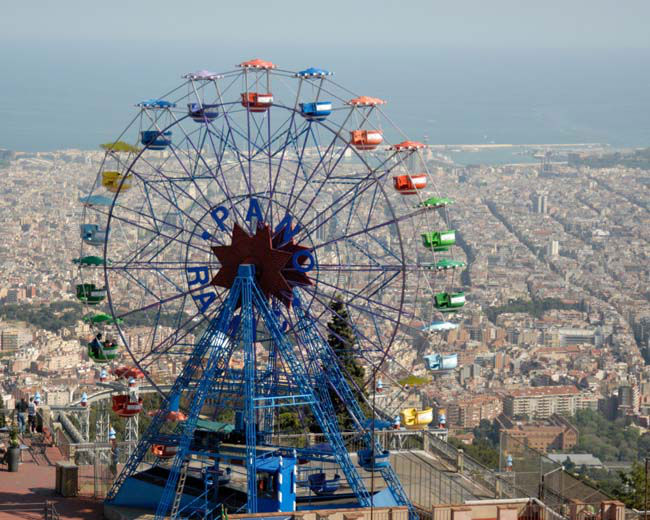
Practically at the foot of the church is the amusement park first opened in 1868 with 25 rides. The park is flushed with old rides that look out of horror movie if they were to come alive at night. These rides are pegged into the hillside and draw huge crowds during the summer, but are quiet at other times of the year – paving way for an adult play-land – and a personal recommendation to take a spin on ferris wheel or the revolving ‘catapult’-type machine for the most amazing/stomach churning views. I rode this with every friend who visited and though everyone was a least a little terrified, they were ultimately thrilled!
This setting was so magical, that for David’s 30th birthday, I planned a surprise ‘getaway’ to a converted monastery nearby the church – now the 5-star Gran Florida Hotel and Spa. Luckily David’s birthday is in January, so the hotel was practically giving away rooms – we had an incredible suite with a large private deck overlooking all of Barcelona for $150/night. The spa setting is stunning and the hotel restaurant is one of the top city recommendations with floor-to-ceiling windows atop a lush garden sweeping views to the shimmering vistas below.

Moving just beyond the city limits is a most jaw-dropping, goose-bump inducing setting – next mountaintop is Montserrat. About a 45min train ride outside of Barcelona, you embark upon an unforgettable ‘pilgrimage’ of sorts. This tucked away mountaintop sanctuary of tranquility was anything but tranquil during the reign of Napoleon. The lure of Montserrat dates back to the 800’s A.D. The history here is fascinating – visions of the Virgin Mary were reported in a cave 4,000feet up in these ‘serrated mountains’ (mont-serrat) – and in the year 1025 an Abbey was built and the location started to receive pilgrims. The Benedictine Abbey came under attack by Napoleon during the French War of 1808 and again during the Spanish Civil War – yet, the Catalan government was able to save Montserrat from being attacked and destroyed.

One ultimately arrives by funicular or by a connecting fast-weaving bus ride along winding roads. The main attraction here is the church. As you walk up to the church entrance, there is a feeling of being dwarfed by the towering serrated mountains popping out behind the few buildings dotted along the road. Entering the church, I recall immediately feeling a sense of happening upon a hidden treasure trove of rich gilding tucked into the mountaintop. Probably one of the most memorable and beautiful churches I have seen, the influence of Moorish hanging lanterns of many colors are stunning and there is the feeling of awe as you are drawn towards to altar of the church.

As I walked further and further into the church, I kept thinking about the monks who still live here in total silence, aside from their daily prayer and chants. As I continued along, a group of 50 young boys began to appear dressed in white robes and they quickly assembled around the altar and began a ‘concert’ – they perform twice daily and I highly recommend checking the times and being there to see them. The boys choir, L’Escolonia Choir, dates back to the 1200’s. They currently travel the world singing and have recorded over 100 albums – their music is heavenly, to say the least.
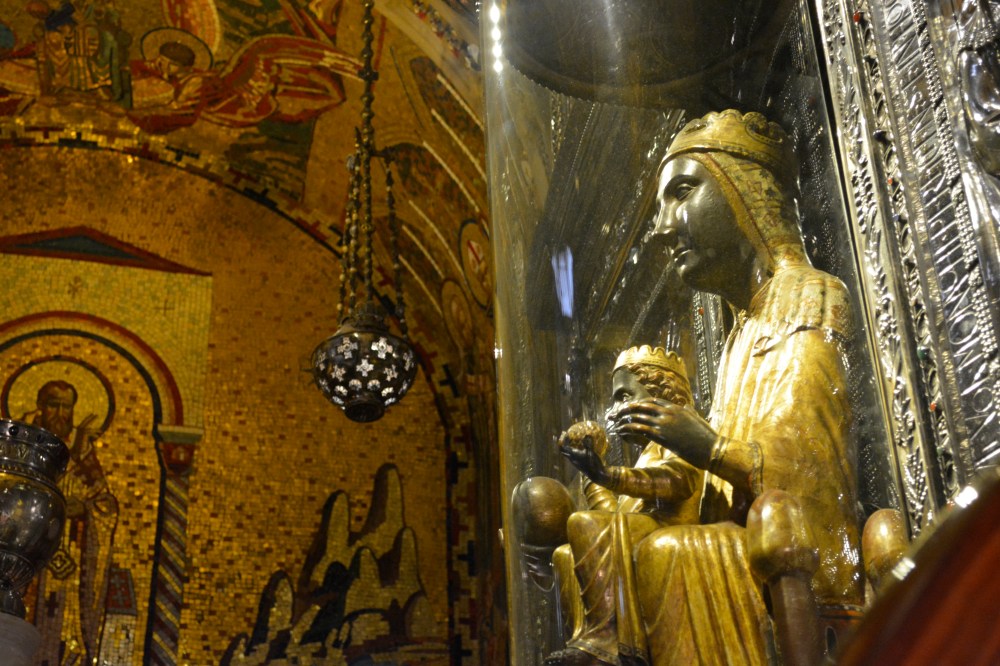
The piece-de-resistance, so-to-speak, is the reason for the pilgrimage – to pay homage to the ‘Lady of Montserrat’ – a beautiful wood-carved statue of Mary, holding an orb with baby Jesus sitting in her lap. This statue has withstood the test of time, surviving many bombings and pillaging of the monastery. As the patron saint of Catalonia, the Lady of Montserrat is revered. People from all over the world, make their way to walk up behind the altar of the church and wait in line to reach out and touch the wooden orb in Mary’s hand. The statue is set in the most spectacular of gilded settings – gold tiles and glittering scenes over looking all of the church. Don’t expect nice food atop this mountain – just a cafeteria setting and gift shop – but the experience and education is worth the trip. David and I traveled here with his parents and brought with us baguettes of bread, cheese, jamon and a bottle of sparkling water and enjoyed sitting on a bench over looking the valley below – a bit nicer than the indoor cafeteria.
TIP Don’t expect to stay too long at this setting – but plan on at least half-a-day, as the travel time will add up.
 Women del Mundo